

Live Deal Review:
Business Bank Statement File Review

Real-World Self-Employed Borrower Qualification Example
Borrower Snapshot
Before reviewing the income calculation, let's understand the borrower.
Borrower Profile
Borrower Type: Self-Employed Business Owner
Business Ownership: 100%
Business Age: 5 Years
Occupancy: Primary Residence
Loan Purpose: Purchase
Credit Score: 720
Challenge: Tax returns show significant write-offs and do not provide enough qualifying income for conventional financing.
Objective
Determine whether the borrower can qualify using Business Bank Statements instead of tax returns.
Step 1: Identify
Why Doesn't Traditional Financing Work?
Like many successful business owners, this borrower maximizes legitimate tax deductions.
While that strategy may reduce taxable income, it can also create challenges when applying for a mortgage.
The borrower has strong cash flow, but the tax returns do not accurately reflect the income available to support mortgage payments.
This is one of the most common Non-QM opportunities.
Step 2: Structure
This allows us to:
✓ Review deposits directly
✓ Analyze real business activity
✓ Establish consistent cash flow
✓ Determine qualifying income using lender-approved expense factors
The goal is not to create income.
The goal is to accurately represent income that already exists.
What's the Best Qualification Strategy?
Rather than relying on tax returns, we'll evaluate the borrower's actual business cash flow using Business Bank Statements.
Step 3: Validate
Business Bank Statement Checklist
✔ Completed business questionnaire
✔ 12 months business bank statements
✓ Borrower ownership percentage verified
✓ Business operating for required time period
✓ Deposit consistency reviewed
✓ Business type identified
✓ Expense factor confirmed
✓ Property eligibility confirmed
Before calculating income, verify the file meets basic eligibility requirements.
Income Calculation Walkthrough
Download the calculator and follow along.
Feel free to use your own numbers.
Step 1:
Review total deposits for the required statement period. Identify any deposits that should be excluded, including:
✓ Transfers
✓ Returned items
✓ Non-business deposits
✓ One-time anomalies
The goal is to determine true qualifying deposits.
Calculate- Gross Business Deposits
Start with total deposits shown on the Business Bank Statements.
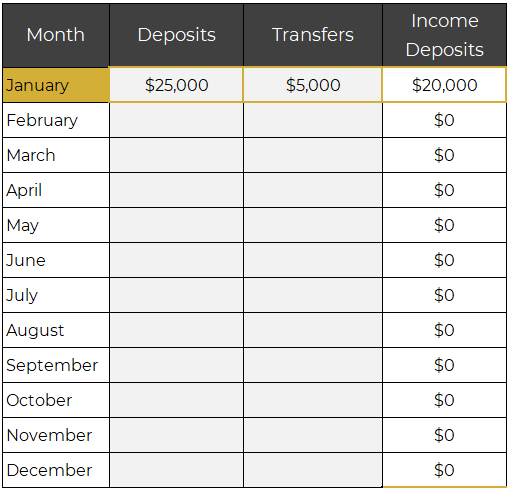
Our borrower has $25,000 in total deposits and $5,000 ineligible deposits.
Calculator Entries: Month 1
$25,000 monthly deposits
$5,000 monthly transfers
Results:
$20,000 business deposits
Step 2:
Calculate the monthly deposits for the last 12 months to get the full picture.
This provides the foundation for determining accurate monthly qualifying income.
Some businesses get paid large amounts, but infrequently.
Some can be seasonal or might have big swings in monthly deposits.
Reviewing a full year will help to average the income into a monthly total.
Review: 12 Months of Bank Statements
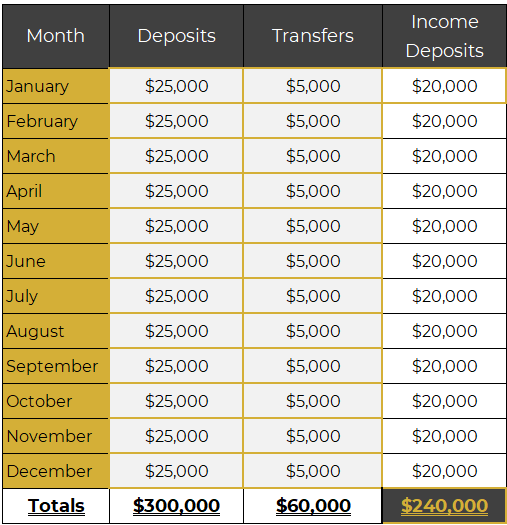
Calculator Entries:
$25,000 monthly deposits
$5,000 monthly transfers
12 months total
Results:
$300,000 total deposits
$60,000 ineligible
$240,000 income deposits
Our borrower’s business bank statements show $240,000 gross income.
Step 3
Apply the appropriate expense factor.
Expense factors vary by business type and lender requirements.
This adjustment accounts for normal operating expenses associated with the business.
Some lenders will use a standard 50% starting point, while others will adjust based on the size and scope of the business.
Enter the expense factor.
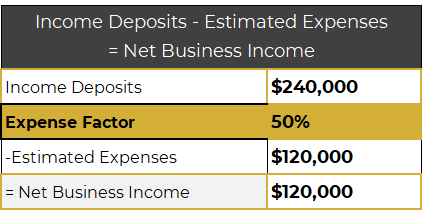
Calculator Entries:
Expense Factor- 50%
Results:
Estimated Expenses - $120,000
$240,000 × 50%
Net Business Income - $120,000
$240,000 - $120,000
Step 4
Convert Net Business Income for the company into Personal Income for the file.
Once the expenses have been calculated, the total is multiplied by the borrower’s share of the company.
This information should be asked up front and not assumed.
For example. If they own 100% of the company, they are entitled to 100% of the income.
If they own 50%, they are only entitled to 50%,
Apply Ownership Percentage
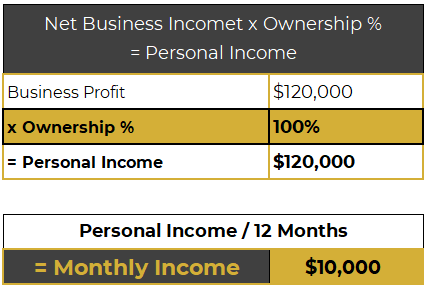
Calculator Entries:
Ownership - 100%
Results:
Net Business Income - $120,000 × 100%
Personal Income - $120,000 annually
$120,000 × 100%
$10,000 Monthly Income
$120,000 / 12 months
Coaching Note:
Lenders will calculate the income for you on your file, but understanding the calculation will allow you to become the expert and stop guessing at approvals.
You can always start by spot checking a few months of deposits to see if they are consistent. That will give you a quick idea of the income potential.
Common Loan Officer Mistakes
⚠ Counting transfers as qualifying income
⚠ Not addressing declining deposits
⚠ Using personal deposits in a business analysis
⚠ Failing to verify ownership percentage
⚠ Applying the wrong expense factor
⚠ Ignoring large unusual deposits
⚠ Missing reserve requirements
Many Business Bank Statement issues are avoidable when the file is reviewed carefully before submission.
Outcome
Why This Structure Worked
The borrower was financially strong.
The challenge was not repayment ability.
The challenge was documentation.
This is where inexperienced loan officers lose deals.
They stop at the tax returns.
Experienced Non-QM originators ask:
“How does this borrower actually make money?”
Business Bank Statements allowed us to evaluate actual cash flow rather than relying exclusively on taxable income.
The result was a qualifying income figure that created a clear path to approval.
Key Lessons
✓ Start by identifying why conventional financing fails.
✓ Choose the cleanest qualification strategy.
✓ Validate eligibility before calculating income.
✓ Review deposits carefully.
✓ Understand expense factor requirements.
✓ Business Bank Statements are often the strongest solution for self-employed borrowers with significant tax deductions.
Framework Review
Identify
Tax returns did not support qualification.
Structure
Business Bank Statements selected.
Validate
Eligibility requirements confirmed.
Calculate
Income determined using business deposits and expense factors.
Outcome
Borrower qualified using actual business cash flow.
Before moving to the next scenario, notice how the Non-QM Gold Framework was applied: