


Live Deal Review:
Asset Depletion File Review
Real-World Asset-Based Qualification Example
Borrower Snapshot
Before reviewing the calculation, let's understand the borrower.
Borrower Profile
Borrower Type: Retired Executive
Employment Status: Retired
Occupancy: Primary Residence
Loan Purpose: Refinance
Credit Score: 760
Challenge: Limited employment income despite substantial liquid assets.
Objective:
Determine whether the borrower can qualify using Asset Depletion instead of traditional employment income.
Many financially strong borrowers no longer receive traditional employment income.
Retirees, semi-retired borrowers, business owners who have sold their companies, and high-net-worth individuals often have significant assets but limited monthly income.
Traditional underwriting may struggle to document sufficient qualifying income despite substantial financial strength.
The challenge is not the borrower's ability to repay.
The challenge is how that repayment ability is documented.
Why Doesn't Traditional Financing Work?
Step 1: Identify
Step 2: Structure
What's the Best Qualification Strategy?
Rather than relying on tax returns, we'll evaluate the borrower's eligible assets.
Asset Depletion programs convert qualifying assets into a monthly income stream for mortgage qualification purposes.
This approach is commonly used for:
✓ Retirees
✓ High-net-worth borrowers
✓ Semi-retired individuals
✓ Borrowers living primarily from investments
✓ Borrowers between careers
The goal is to determine whether existing assets can reasonably support the proposed mortgage obligation.
Coaching Note:
Many loan officers assume a borrower needs employment income to qualify. Asset Depletion often proves otherwise.
Step 3: Validate
Asset Depletion Checklist
✓ Asset statements collected
✓ Asset seasoning verified
✓ Eligible asset types confirmed
✓ Required reserves reviewed
✓ Property eligibility confirmed
✓ Credit profile reviewed
✓ Asset ownership verified
✓ Lender-specific depletion methodology confirmed
Once eligibility is verified, the income calculation can begin.
Before calculating income, verify the assets meet the program requirements.
Income Calculation Walkthrough
Download the Personal Bank Statement to follow along or use your own calculations.
Step 1
Begin by identifying the type of accounts along with the current balances.
Examples may include:
✓ Checking accounts
✓ Savings accounts
✓ Money market accounts
✓ Stocks and bonds
✓ Retirement accounts
✓ Investment accounts
Download the Asset Depletion Calculator and follow along.
Calculator Entries:
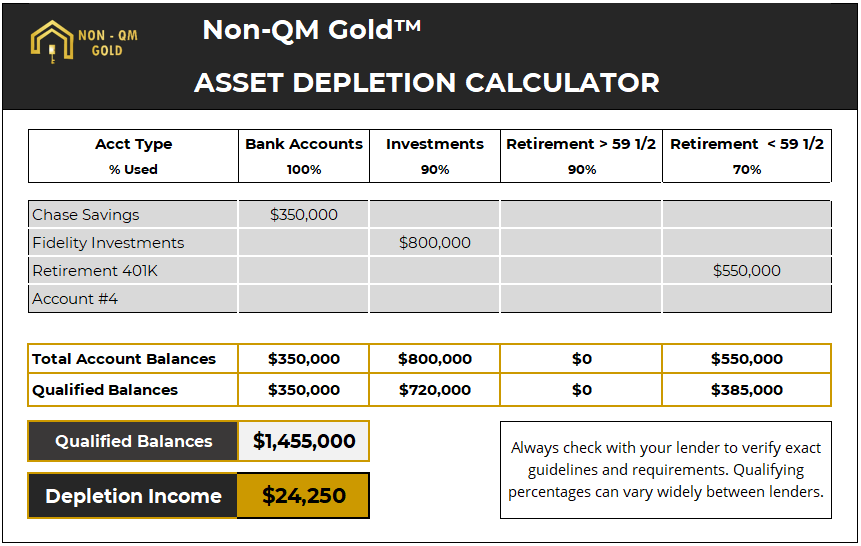
Savings - $250,000
Enter in Bank Accounts column
Investments - $1,000,000
Enter in Investments column
Results:
$1,250,000 in total current balances
$250,000 + $1,000,000 = $1,250,000
Step 2
Determine the adjusted qualified assets.
This step determines the total amount that can be used to calculate monthly asset depletion income.
Lenders do not always allow 100% of every account.
Example guidelines:
Bank Accounts: - 100%
Investment Accounts: - 90%
Retirement Accounts: - 70% if borrower is 59½+
65% if younger
These adjustments account for volatility and access restrictions.
Enter the balances into the correct column of the calculator.
The calculator does the work for you.
Calculator Entries:
None
Results:
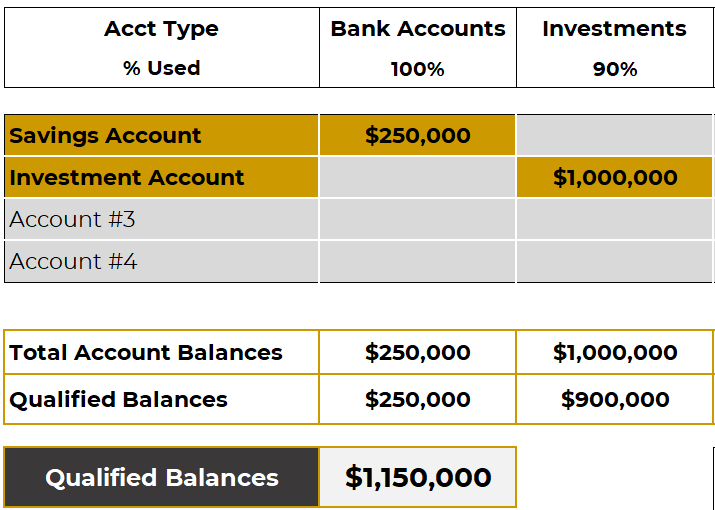
Savings - $250,000 × 100%
= $250,000 qualified balance
Investment Account - $1,000,000 × 90%
= $900,000 qualified balance
Total Qualified Assets - $1,150,000
Step 3
Apply the lender's depletion period.
Asset depletion programs divide qualified assets over a specified number of months to create qualifying income.
Many lenders will use 60-months for the depletion period, but each lender can have different parameters.
The resulting figure becomes the borrower's monthly qualifying income.
This income can be added to other income types, such as W2 or bank statements.
Convert Assets Into Income
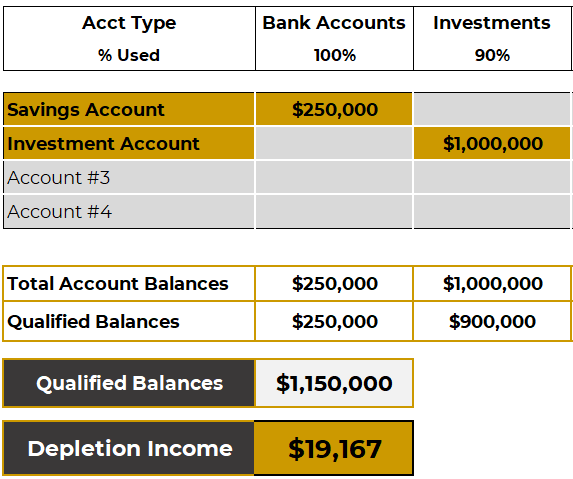
This is where the magic happens. Qualified assets are spread over: 60 months (5 years) and converted into income.
Calculator Entries:
None required- Calculation is instant.
Results:
Monthly Qualifying Income: - $19,167/month
$1,150,000 ÷ 60 months
Common Loan Officer Mistakes
⚠ Including ineligible assets
⚠ Using outdated asset statements
⚠ Missing lender-specific qualified percentages
⚠ Overlooking reserve requirements
⚠ Failing to verify ownership
⚠ Using the wrong depletion period
Many Asset Depletion issues result from guideline misunderstandings rather than borrower weaknesses.
Outcome
Why This Structure Worked:
The borrower had significant financial strength but limited traditional income.
Rather than forcing the borrower into an employment-based qualification model,
Asset Depletion allowed us to evaluate the resources already available to support the mortgage.
The result was a clear, defensible income calculation based on documented assets.
The borrower didn't need more income.
The borrower needed a different qualification strategy.
Key Lessons
✓ Asset-rich borrowers are often overlooked opportunities.
✓ Employment income is not always required.
✓ Asset Depletion converts assets into qualifying income.
✓ Different lenders use different depletion methodologies.
✓ Asset validation is just as important as income validation.
✓ Strong assets can create a very clean path to approval.
Framework Review
Identify
Traditional income was insufficient.
Structure
Asset Depletion selected.
Validate
Eligible assets and program requirements confirmed.
Calculate
Qualifying income created using lender-approved asset depletion methodology.
Outcome
Borrower qualified using accumulated wealth rather than employment income.
Before moving to the next scenario, notice how the Non-QM Gold Framework was applied: