


Live Deal Review:
DSCR File Review
Real-World Investor Qualification Example
Borrower Snapshot
Before reviewing the calculation, let's understand the borrower.
Borrower Profile
Borrower Type: Real Estate Investor
Property Type: Single Family Rental
Occupancy: Non-Owner Occupied
Loan Purpose: Purchase
Credit Score: 740
Challenge: Complex tax returns and multiple existing investment properties make traditional qualification difficult.
Objective:
Determine whether the property's rental income can support qualification through a Debt Service Coverage Ratio (DSCR) program.
Step 1: Identify
Why Doesn't Traditional Financing Work?
Many successful investors intentionally minimize taxable income through depreciation and legitimate business deductions.
As portfolios grow, traditional income analysis becomes increasingly complicated.
In many cases, the investor's tax returns do not accurately reflect the property's ability to generate cash flow.
The challenge is not repayment ability.
The challenge is determining the most efficient qualification method.
Step 2: Structure
What's the Best Qualification Strategy?
Rather than qualifying the borrower based on personal income, we'll evaluate the property's ability to support the proposed mortgage payment.
This is the foundation of DSCR lending.
DSCR programs focus on:
✓ Property cash flow
✓ Rental income
✓ Proposed housing expense
✓ Investor profile
The emphasis shifts from the borrower's personal income to the property's performance.
Gold coaching note:
One of the biggest misconceptions in mortgage lending is that every borrower must qualify using personal income. DSCR proves otherwise.
Step 3: Validate
Before calculating DSCR, verify the file meet the program requirements.
DSCR Checklist
✓ Property eligibility confirmed
✓ Rental income verified
✓ Credit requirements reviewed
✓ Reserve requirements confirmed
✓ Investor ownership structure reviewed
✓ Property condition verified
✓ Market rent support confirmed
✓ Loan program eligibility confirmed
Once these items are reviewed, the DSCR calculation can begin.
Income Calculation Walkthrough
Download the DSCR Calculator to follow along with the scenario, or use your own loan scenario.
Step 1
Identify the property's monthly qualifying rental income.
This may come from:
✓ Lease agreements
✓ Appraisal market rent schedules
✓ Existing rental history
The goal is to establish the property's qualifying income stream.
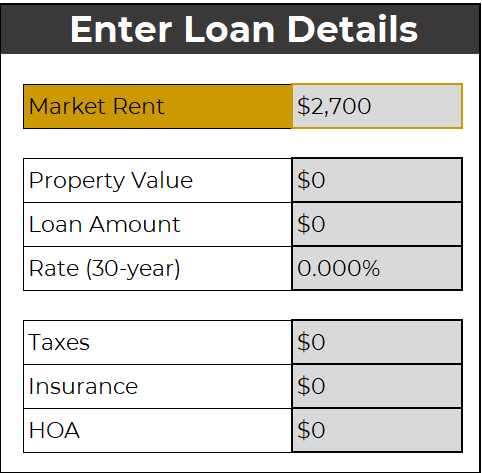
Estimate Market Rent
The first number is expected monthly rent on the subject property.
Calculator Entry:
$2,700 Market Rent
Step 2
Determine the proposed monthly housing expense.
This typically includes:
✓ Principal
✓ Interest
✓ Property Taxes
✓ Insurance
✓ HOA dues (if applicable)
This creates the total monthly obligation.
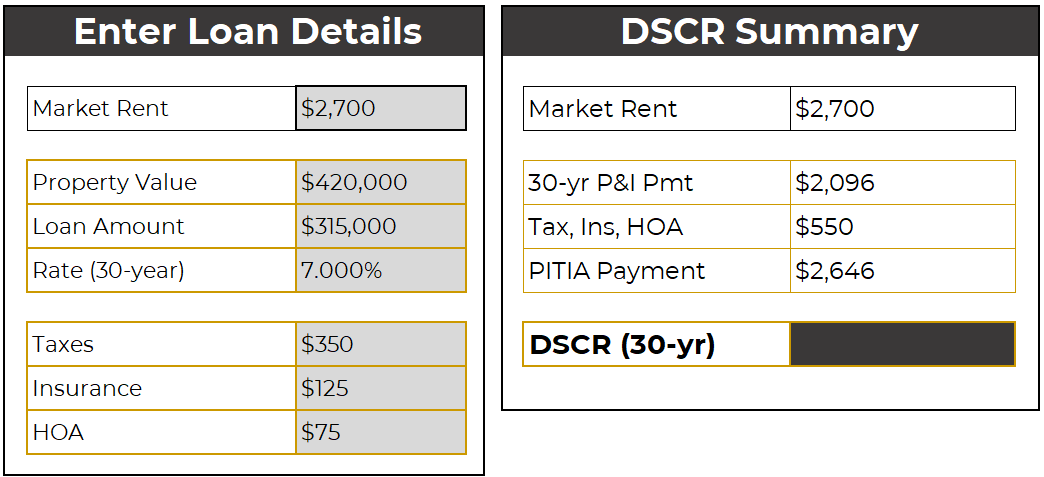
Calculate Mortgage Payment
Again, the calculator will do the work for you.
Calculator Entries:
Loan Amount - $315,000
Rate: - 7.00%
Property Taxes - $350
Insurance: - $125
HOA: - $75
Results:
P&I Payment: - $2,096
Taxes + Insurance + HOA - $550
Total Payment - $2,646 per month
Step 3
Calculate the Debt Service Coverage Ratio.
DSCR compares:
Monthly Rental Income
divided by
Monthly Housing Expense
The resulting ratio indicates whether the property's rent supports the mortgage payment.
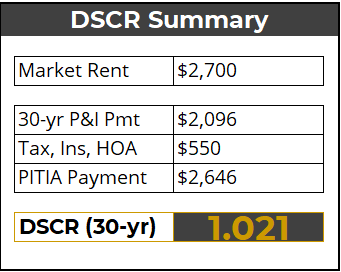
Calculate DSCR
Formula: Rent divided by the full mortgage payment.
Calculator Entries:
None: The Calculator shows you instantly.
Results:
DSCR - 1.021
Rounded - 1.02 DSCR
$2,700 Rent / $2,679 PITIA
Above 1.00 = Positive cash flow
1.00 = Break-even
Below 1.00 = Property income does not fully cover debt service
Review the final DSCR result and confirm program eligibility.
Different lenders may require different minimum ratios depending on the scenario.
Remember, the rent is not typically verified until the appraisal is completed with the 1007 rent schedule.
What Does That Mean?
This property covers:
100.8% of the mortgage payment
That means:
The property technically cash flows.
Barely. But it qualifies.
What If The Numbers Change?
This matters more than most loan officers realize.
If rent drops or the interest rate rises:
DSCR falls.
Example:
If DSCR drops below 1.0:
Some lenders may still approve.
But likely with:
Lower maximum LTV
Higher pricing
Stricter overlays
Always stress-test the numbers.
Common Loan Officer Mistakes
⚠ Using incorrect rental income
⚠ Forgetting HOA dues
⚠ Miscalculating housing expense
⚠ Assuming all lenders use identical DSCR requirements
⚠ Ignoring reserve requirements
⚠ Failing to verify property eligibility
Many DSCR issues originate from incomplete validation rather than the actual calculation.
Outcome
Outcome
✓ Rental Income- $2,700
✓ Housing Expense- $2,646
✓ Final DSCR - 1.02
✓ Eligible for Program
Why This Structure Worked
The investor owned multiple properties and had complex tax returns.
Traditional qualification would have required extensive income analysis.
Instead, DSCR allowed us to focus on the property's ability to generate income.
The property supported the proposed mortgage payment, creating a cleaner and more efficient path to approval.
The solution was not more documentation.
The solution was a different qualification strategy.
Key Lessons
✓ DSCR focuses on property performance rather than personal income.
✓ Investors often qualify more easily through DSCR than traditional underwriting.
✓ Property cash flow becomes the primary qualification factor.
✓ Validation remains critical even when income analysis is simplified.
✓ Understanding rental income calculations is essential.
✓ DSCR programs create significant opportunities for real estate investors.
Framework Review
Identify
Traditional qualification was unnecessarily complicated.
Structure
DSCR selected.
Validate
Property, borrower, and program eligibility confirmed.
Calculate
Property income compared against housing expense.
Outcome
Investor qualified based on property cash flow.
Before moving to the next scenario, notice how the Non-QM Gold Framework was applied: