


Framework: Steps 5–8:
Address, Validate, Submit, & Control
Turning new applications into funded loans.

Step 5: Address Deal Killers
Before submission, pressure-test the file.
Credit concerns?
Reserve weakness?
Income documentation?
Citizenship eligibility?
Property restrictions?
Condo concerns?
Occupancy conflicts?
Foreign fund timing?
Documentation gaps?
Unusual deposits?
Vesting issues?
Strong originators find potential issues before underwriting does.
That gives you full control of the file.
Step 6: Validate Documentation

Before submitting the file, validate the fundamentals and address the deal killers.
Review:
✓ Borrower credit & eligibility
✓ Property eligibility
✓ Income & DTI
✓ Reserves
✓ Credit profile
✓ Vesting structure
✓ Source of funds.
This is where many future problems are prevented
Step 7: Submit Full Files

The strongest submissions are:
✓ Complete
✓ Organized
✓ Clearly explained
✓ Proactively documented
✓ Tell the full story
Many Non-QM problems begin at submission.
Your job is not to submit quickly. Your job is to submit intelligently.
Until you get comfortable with this step, I recommend that you discuss and review new files with an experienced an trusted account executive to help identify potential challenges.
Think like an underwriter.
What questions will they ask?
Answer those questions before they ask them.

Step 8: Control the Process
This is where top producers separate themselves.
Once submitted:
✓ Review conditions quickly
✓ Maintain communication with lender and borrower
✓ Keep borrowers informed of time frame and next steps.
✓ Resolve issues proactively
✓ Avoid surprises
Your job is not finished at submission.
Your job is maintaining momentum.
The Non-QM Gold Mindset
When files feel organized, everyone benefits:
✓ Borrowers
✓ Realtors
✓ Processors
✓ Underwriters
✓ Referral partners
The goal is not simply to get approvals.
The goal is to maintain control from initial conversation through funding.
Framework Summary
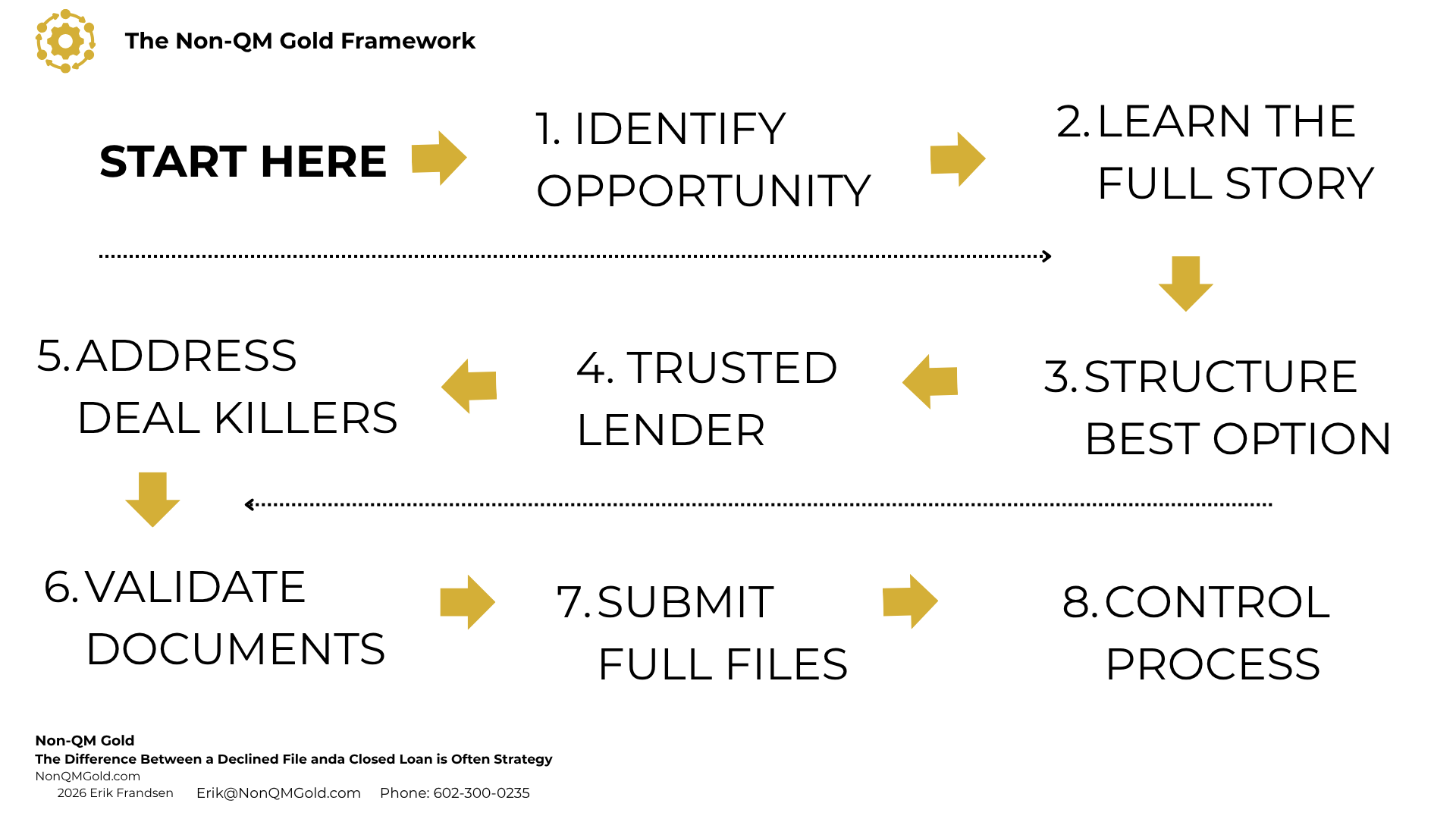
Simple.
Repeatable.
Scalable.
This process can be applied to virtually every Non-QM opportunity you'll encounter.
Before Moving Forward
You now have a framework for evaluating and structuring Non-QM opportunities.
Next, we'll apply everything you've learned to real borrower scenarios and walk through the income calculations and exact thought process used to structure each file.